Popular search terms
  • Biosecurity toolkit
  • Contact us
  • What is biosecurity?
  • Farm Biosecurity Program
  • Plant pest responses
  • Animal disease response
  • Farm profiler
  • Toolkit
  • Subscribe
  • About
    • About the Farm Biosecurity Program
    • Emergency animal disease responses
    • Emergency plant pest responses
  • Essentials
    • Farm inputs
    • Farm outputs
    • Ferals & weeds
      • Wild dog biosecurity
    • People, vehicles & equipment
    • Production practices
    • Train, plan & record
    • Videos
  • Toolkit
    • Gate sign
    • Create your own biosecurity kit
    • Declarations
    • Manuals
    • On-farm biosecurity planning
    • Records
  • Crops
    • Cotton
      • Cotton best management practice
      • Cotton product management
      • Cotton pests
    • Feed mills
    • Fruit & nuts
      • Fruit & nut pests
        • Apple and pear pests
        • Avocado pests
        • Banana pests
        • Cherry pests
        • Citrus pests
        • Mango pests
        • Nut pests
        • Papaya pests
        • Summerfruit pests
      • Fruit & nut product management
    • Grains
      • Grains pests
      • Grains product management
      • Grain storage options
    • Honey bees
      • BeeAware website and newsletter
      • Code of Practice and National Bee Biosecurity Program
      • Honey bee glossary
      • Honey bee product management
      • Honey bee pests
      • Honey bee best management practice
      • Beekeeper advisory – mosquito insecticide control during the 2022 Japanese encephalitis outbreak
    • Nursery & garden
      • Nursery & garden pests
      • Nursery & garden product management
      • Nursery & garden best management practice
    • Onions
      • Onion pest threats
      • Onion pest eradication or control examples
    • Plantation forestry
      • Forestry biosecurity practices
      • Forestry pests
      • Hypothetical exotic bark beetle incursion
      • Plantation forestry quality assurance
    • Potatoes
      • Potato pest threats
      • Potato biosecurity areas
    • Sugarcane
      • Sugarcane best management practice
      • Sugarcane biosecurity essentials
      • Queensland Sugarcane Biosecurity Zones
      • Sugarcane pests and weeds
    • Vegetables
      • Vegetable pests
      • Vegetable product management
    • Viticulture
      • Phylloxera
      • Viticulture pests
      • Viticulture product management
  • Livestock
    • Alpacas
    • Beef cattle
    • Chickens
    • Dairy cattle
    • Ducks
    • Eggs
    • Feed mills
    • Goats
    • Horses
      • Mosquito Management for Horses
    • Lot feeding
    • New and emerging livestock industries
    • Pigs
      • Feeding your pigs
      • Controlling mosquitoes around piggeries
    • Ratites
    • Sheep
    • Zoo animals
  • Get help
    • Animal health and biosecurity extension
      • Property biosecurity management planning
  • News
    • E-newsletter
    • Subscribe to Farm Biosecurity News
  • Stories
  • Videos

What to do when something looks unusual

Print this page
  • Home
  • News
  • What to do when something looks unusual

What to do when something looks unusual

Most growers notice changes during everyday work. A patch that looks different, an insect you do not recognise, unexpected damage or symptoms that do not fit the season can all be early signs of a pest or disease issue.

Not every unusual sign will be serious. Many reports are checked and ruled out. But reporting early helps confirm what is happening and gives biosecurity staff the best chance to respond if a new or unusual pest or disease is present.

You do not need to know exactly what the pest or disease is before reporting it. If something does not look right, the first steps you take can help reduce the risk of it spreading.

Stop and check

If you see something unusual, take a moment to record what you can. This may include:

  • clear photos of the pest, symptoms or damage
  • the date and location
  • the crop, variety or plant affected
  • how widespread the issue appears to be
  • any recent movement of people, vehicles, equipment, plant material or soil in the area.

If possible, mark the affected area with a peg, flag or tape so it can be found again.

Avoid spreading the risk

Until you receive advice, try to minimise movement around the affected area:

  • avoiding movement of plant material, soil, equipment or vehicles from the area
  • limiting access by staff, visitors or contractors
  • cleaning tools, boots and equipment that may have come into contact with affected plants or soil
  • keeping any sample secure if it is safe to collect.

Do not send samples or move affected plant material unless you have been advised to do so.

Make the call

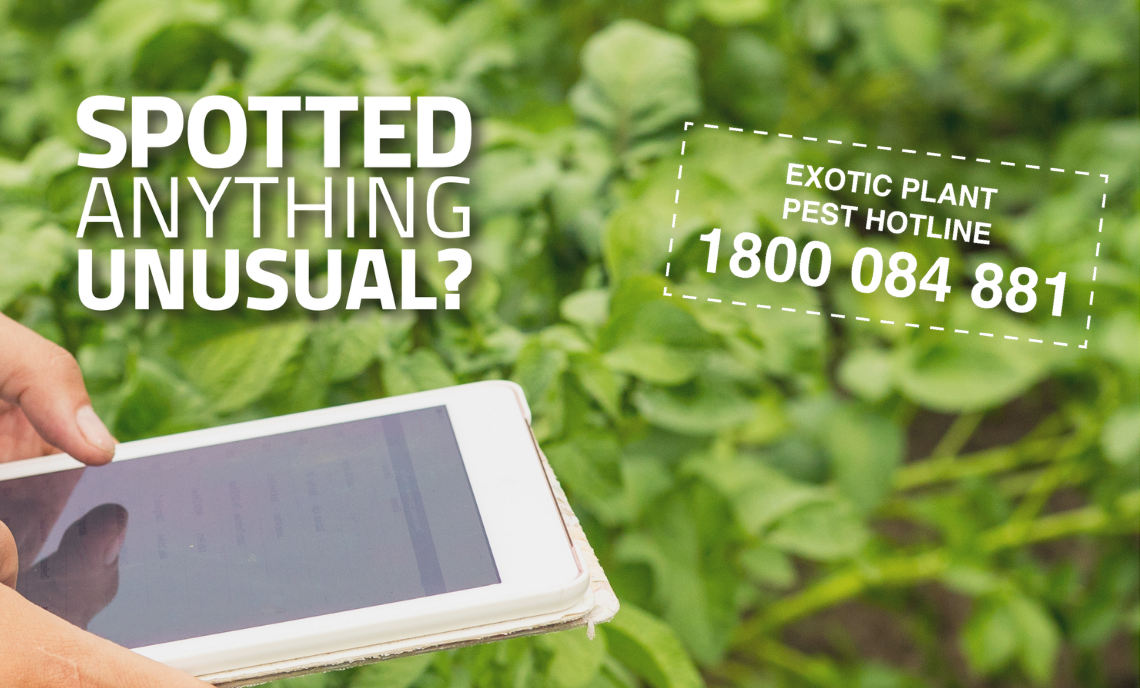
Report unusual plant pests or symptoms to the Exotic Plant Pest Hotline on 1800 084 881.

The hotline will connect you with the relevant state or territory biosecurity agency. You may be asked to provide information about what you found, where it was found, what crop is affected and how widespread the issue appears to be.

Photos, location details and a clear description of what you are seeing are a useful starting point. If more information is needed, biosecurity staff will let you know what to do next.

What happens next

After a report is made, biosecurity staff may contact you for more information, review photos or arrange to inspect the site if needed.

If further investigation is required, samples may be collected for diagnosis and advice provided on how to manage the affected area while results are being confirmed.

A report does not automatically mean there is a major problem. It helps biosecurity staff assess the situation and decide whether any further action is needed.

Find out more about what happens after a report is made.

Make reporting easier

Reporting is easier when basic farm biosecurity practices are already in place. Regular monitoring, clear records and staff who know what is normal for your property can all help you respond quickly when something unusual appears.

Find out more about checking what’s normal to spot problems early.

If something does not look right, take photos, make a note and report it. A quick call can help protect your property and reduce the risk to neighbouring properties and the wider industry.

Read the latest information on
Foot-and-mouth disease

Read the latest information on
Lumpy skin disease

Read the latest information on
Japanese encephalitis

Subscribe to our newsletter

Farm Biosecurity News

Use our profiler to make your

Biosecurity Toolkit

Latest News
  • 14 July 2026

    What to do when something looks unusual
  • 14 July 2026

    National Biosecurity Week 2026
  • 10 July 2026

    Quarantine your new livestock like a pro
  • 25 June 2026

    Updated Cattle Health Declaration now available
  • 23 June 2026

    Records that protect your business

Emergency Animal Disease Hotline
1800 675 888

Exotic Plant Pest Hotline
1800 084 881

  • Sitemap
  • Copyright
  • Contact us
  • Privacy & Disclaimer
  • Website by Morph Digital